Key Takeaway For Food Manufacturers
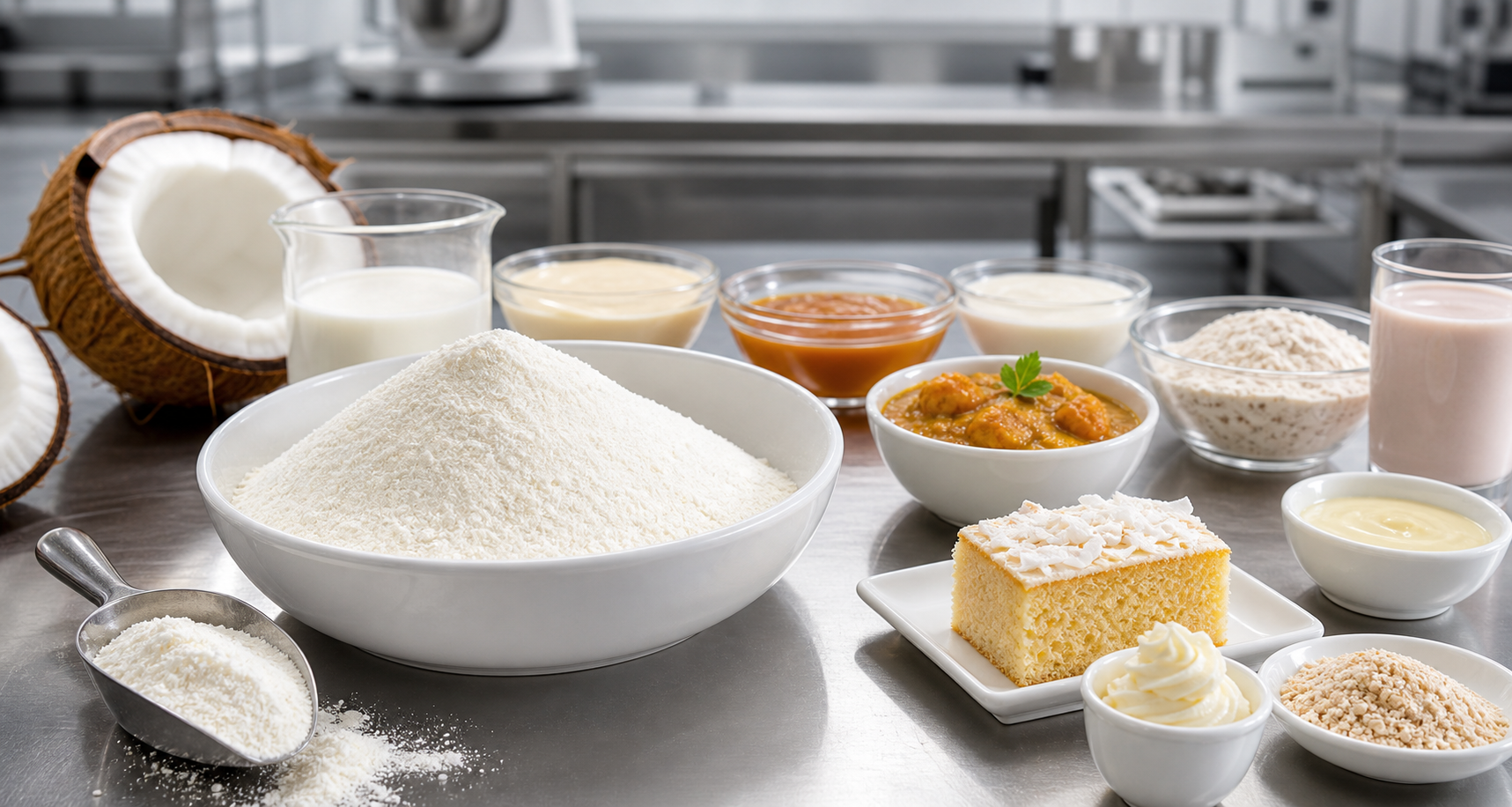
Coconut milk powder is a dry, spray-dried form of coconut milk or coconut cream. In most commercial formats, coconut milk or cream is emulsified with a carrier system such as maltodextrin, sometimes with a protein-based emulsifier, then spray dried into a shelf-stable powder. The exact fat percentage, carrier, allergen profile, packing, MOQ, and certification status belong to the supplier's current specification.
Food manufacturers use it in sauces, curries, bakery fillings, desserts, beverages, instant mixes, dry blends, and prepared foods. It is chosen when a production team wants coconut flavour, coconut fat, opacity, body, and dry-ingredient convenience without managing liquid coconut milk in every batch.
The main reasons manufacturers choose the powder are dosing-by-weight consistency, dry storage, lower transport weight than liquid, easier dry blending, and the ability to reconstitute coconut character only when the recipe or process needs it.
What Is Coconut Milk Powder Used For In Food Manufacturing?
The ingredient gives manufacturers a dry way to add coconut milk character into commercial recipes. It is not just a flavouring. A typical powder carries coconut fat and coconut solids in a dried emulsion matrix, so it affects taste, aroma, colour, viscosity, mouthfeel, and process behaviour.
Public commercial specifications show that fat content varies widely by product design. Market examples include 30% fat retail milk powders, 50% +/- 5 organic milk powders, 55 g total fat per 100 g product, 60% +/- 5 bulk powders, and richer coconut cream powders around 63-65% fat. Treat these as category examples, not S&P specifications; S&P's exact fat percentage and ingredient declaration must come from its current product specification.
The ingredient needs water, mixing energy, and enough hydration time to behave like a coconut milk phase again. In some processes it is pre-dispersed in water before use. In others it is blended with dry ingredients first, then hydrated during cooking, mixing, or consumer preparation.
Common Application Areas For Coconut Milk Powder
| Application area | Why manufacturers use this format | Main process checks |
|---|---|---|
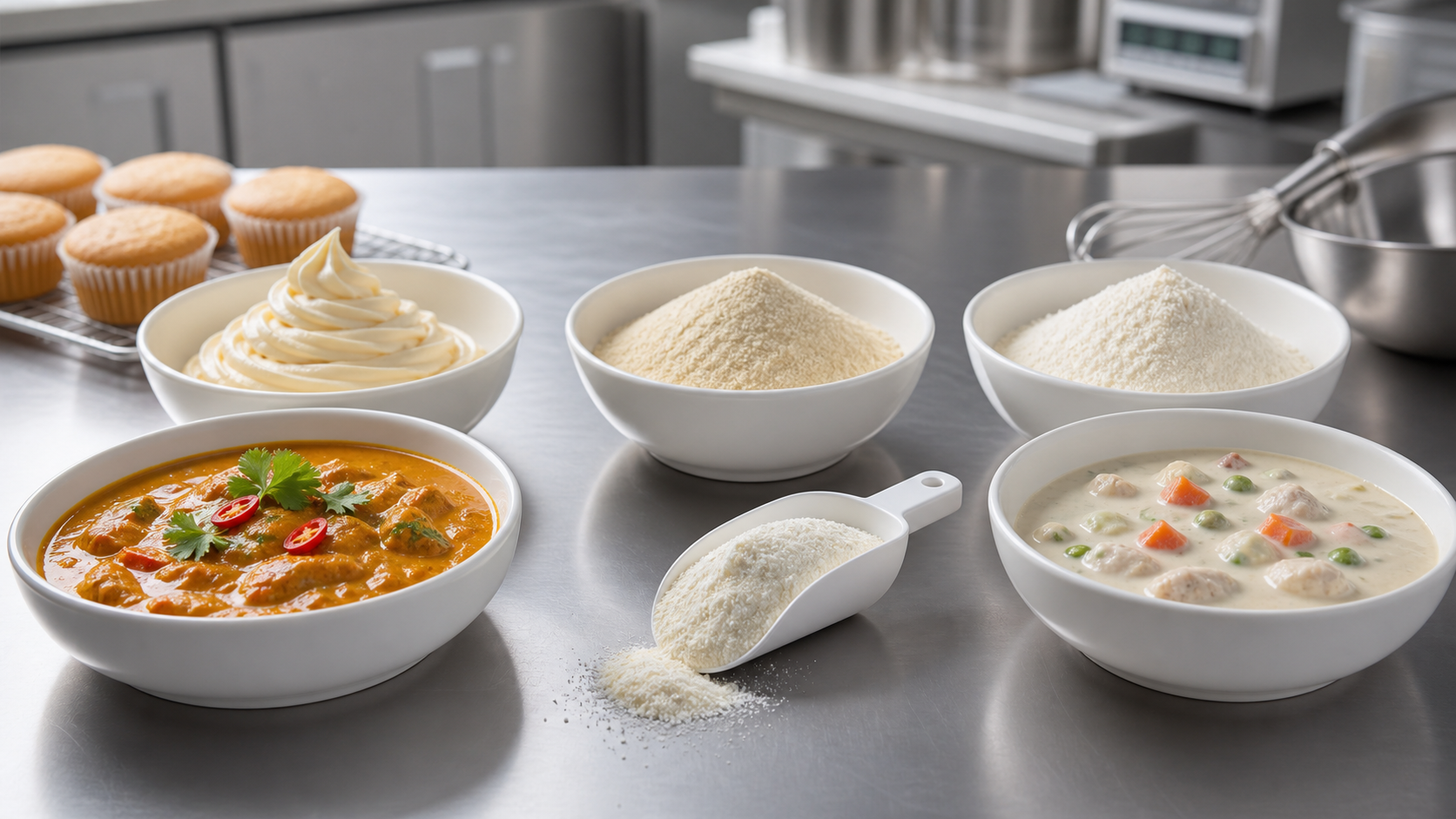
| Sauces, curries, and savoury products | Adds coconut flavour, opacity, fat-related mouthfeel, and body in cooked sauce systems | Pre-hydration, shear, heat load, salt level, acidity, viscosity, emulsion stability |
| Bakery, fillings, and desserts | Adds coconut solids and creaminess while staying easy to weigh into dry or semi-dry recipes | Fat level, water addition, bake stability, filling texture, starch/gum interaction, storage texture |
| Beverages, instant mixes, and dry blends | Adds coconut character in a dry, doseable format for sachets, premixes, and powders | Wettability, clumping, sediment, serving temperature, particle size, dry-blend flow |
| Prepared foods and commercial production | Standardises a coconut input for batch production and simplifies storage compared with liquid | Addition point, hydration time, heating step, hold time, packing, chilled/frozen/ambient stability |
Sauces, Curries, And Savoury Food Products
Sauce and curry manufacturers use this format because coconut flavour and coconut fat are both important in savoury coconut systems. The fat phase rounds the flavour, softens spice harshness, increases opacity, and gives a fuller mouthfeel. The coconut solids add body and help the sauce taste more like a coconut base rather than a simple flavour addition.
For cooked sauces, the ingredient is treated as an emulsion ingredient. It performs best when it has enough water and mixing energy to disperse before the sauce becomes too concentrated. If it is added late into a thick, salty, acidic, or high-temperature sauce, the risk of lumps, surface oil, graininess, or uneven flavour distribution increases.
Manufacturers often choose it over liquid coconut milk for sauces when they want tighter dry-weight dosing, simpler storage, and less liquid handling. A batch sheet can specify 10 kg of dry ingredient more easily than managing variable liquid coconut milk drums or cartons. The production team can then control final water addition inside the recipe.
Typical R&D checks:
- powder-to-water ratio;
- mixing order and shear;
- hydration temperature;
- cooking time and final viscosity;
- fat separation after hot holding;
- sauce appearance after cooling.
For retort, pasteurised, chilled, or frozen sauces, the trial should include the real heat and storage conditions because coconut emulsions can change under thermal and storage stress.
Bakery, Fillings, And Dessert Applications
Bakery and dessert producers use the powder when they need coconut flavour plus dry-solids control. In cakes, cookies, fillings, cream layers, puddings, confectionery centres, and dessert powders, it can add coconut aroma, creaminess, opacity, and a smoother fat-related mouthfeel.
The powder works differently from desiccated coconut. Desiccated coconut mainly adds fibre texture and visible coconut pieces. Coconut milk or cream powder adds a dispersed coconut phase, so it can support smoother fillings, cream-style desserts, and batters where visible coconut particles are not wanted.
In bakery systems, fat level matters. A richer grade can soften texture, change spread, and influence crumb tenderness. A lower-fat grade gives coconut flavour and solids with less fat load. The carrier system also matters because maltodextrin contributes dry solids and can affect sweetness perception, water binding, and browning indirectly through the whole formula.
Manufacturers choose this format for bakery because it is easy to weigh with flour, sugar, starches, stabilisers, cocoa, or other dry ingredients. It also avoids adding extra liquid too early.
Key checks:
- fillings and dessert creams: smoothness, spreadability, water activity, syneresis, fat bloom or oiling, and flavour strength after storage;
- baked goods: batter viscosity, bake loss, crumb, browning, and whether the coconut note survives heat.
Beverages, Instant Mixes, And Dry Blends
Beverage and instant-mix manufacturers choose the powder because it can carry coconut character into a dry format. It fits drink powders, coffee and tea mixes, dessert beverages, cereal drinks, powdered premixes, and food-service sachets where liquid coconut milk would complicate manufacturing or shelf life.
The critical behaviour is reconstitution. Because the ingredient contains coconut fat, it does not dissolve like sugar. It wets, disperses, and rebuilds a coconut-like emulsion in water. Good performance means it wets quickly, breaks apart without persistent lumps, gives the expected opacity and mouthfeel, and leaves minimal sediment or surface oil after standing.
For dairy-free, non-dairy, or vegan positioning, manufacturers also need to verify the carrier and emulsifier declaration. Sodium caseinate is a milk-derived protein commonly used in some coconut powders to help stabilise fat content, so the allergen status must be confirmed before any label claim is made.
Instant products often need different powder behaviour from cooked sauces. A sauce factory can use heat and shear. A consumer sachet may only get a spoon, cup, and hot water. For this reason, drink mixes often benefit from powders designed for good wettability or agglomerated particles, while standard fine powders can be more prone to floating or clumping.
Manufacturers choose this format in dry blends for dosing accuracy, sachet filling, lower water activity, and ambient storage.
R&D checks:
- particle size and bulk density;
- dusting, caking, and blend uniformity;
- compatibility with sugar, proteins, cocoa, stabilisers, or flavours;
- performance in the actual serving condition.
Hot-water, warm-water, and cold-water tests can produce very different results.
Prepared Foods And Commercial Food Production
Prepared-food manufacturers use the ingredient to standardise coconut input across larger production runs. It can fit ready meals, curry bases, soups, frozen sauces, chilled sauces, food-service bases, and meal components where coconut character is part of the finished product.
The main advantage is process control. Dry powder is easier to store, weigh, and schedule than liquid coconut milk. It also reduces inbound water, which can lower transport weight and simplify inventory. In a factory, dosing by weight improves repeatability because the recipe can define the exact dry amount and final water balance.
The ingredient still has to be handled like a fat-containing emulsion system. It needs the right addition point, water phase, shear, heat step, and hold time. If hydration is incomplete before packing or thermal processing, the final product can show graininess, uneven viscosity, or oil separation.
Prepared-food trials should mirror the real process:
- same mixing order;
- same heating profile;
- same hold time;
- same packing;
- same chilled, frozen, ambient, or reheating condition.
Bench tasting alone is not enough for this category.
Why Manufacturers Compare Powder With Liquid Coconut Milk
Powder and liquid coconut milk solve different production problems. Liquid coconut milk is already hydrated and can be direct for recipes built around a liquid coconut phase. Powder gives dry storage, compact transport, dosing-by-weight consistency, dry-blend compatibility, and flexible reconstitution.
Manufacturers compare:
- Fat contribution and mouthfeel.
- Final water balance.
- Hydration time and available mixing energy.
- Sauce or beverage stability.
- Powder flow, caking, and storage requirements.
- Label impact from carriers or emulsifiers.
- Cost-in-use, freight, and warehouse space.
- Fit with hot-fill, retort, chilled, frozen, bakery, or instant preparation.
The right format is a process decision. A dry mix or sachet usually favours powder. A fresh sauce line with strong liquid handling may favour liquid. A prepared-food line may trial both and compare flavour, viscosity, stability, and operational cost.

What Buyers Should Confirm Before Sourcing
Use one technical enquiry instead of a long back-and-forth. The supplier needs enough information to match the powder grade to the process and to confirm S & P-specific commercial details.
Before contacting S & P Industries or another supplier, prepare:
- Finished product type: sauce, curry, bakery filling, dessert, beverage, instant mix, dry blend, prepared food, food service, private label, or export product.
- Role of the ingredient: coconut flavour, coconut fat, creaminess, opacity, body, dry-mix convenience, or reconstitution.
- Target fat contribution or desired richness, if known.
- Process: dry blending, pre-hydration, hot mixing, cooking, baking, retort, chilled storage, frozen storage, or instant preparation.
- Trial quantity, first production quantity, and expected repeat volume.
- Preferred packing format, if known.
- Destination market or customer market.
- Required documents: specification, ingredient declaration, allergen statement, shelf life, storage condition, microbiology, country of origin, halal or other certification if required.
- Any restrictions on carriers or emulsifiers, such as maltodextrin, sodium caseinate, or other stabilising ingredients.
- Target timeline for sample, quotation, approval, production, and shipment.
S & P-specific items such as exact fat percentage, carrier system, MOQ, certification, packing, lead time, and export documentation should be confirmed from the current product specification and commercial offer.
View S & P Industries Industrial Coconut Product Supply
Food manufacturers and industrial buyers can review industrial coconut product supply from S & P Industries for commercial coconut product enquiries and application-led sourcing conversations.
Buyers can also review S & P Food coconut milk powder product options for the product/category page.